
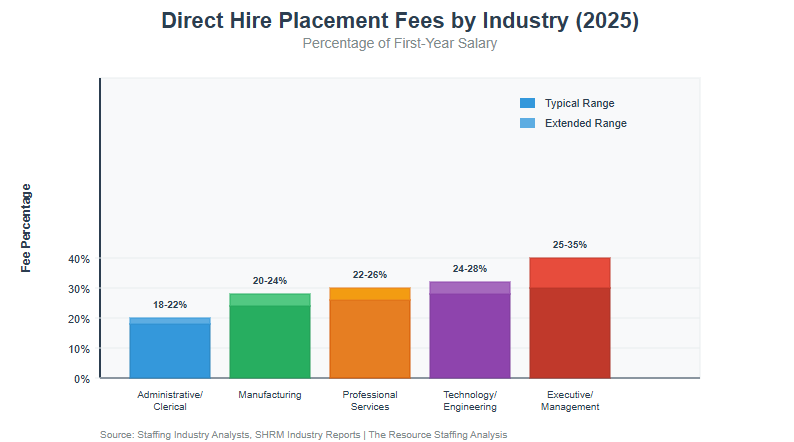
Staffing agency markups typically range from 30% to 75% for temporary and contract placements. Direct hire fees range from 15% to 30% of a candidate’s first-year salary. These figures represent what employers pay above a worker’s base pay rate to cover employment taxes and insurance. Overhead costs and agency profit margin make up the remainder. Despite how commonly staffing services are used, markup structures remain among the least transparent pricing elements in workforce management.
This analysis draws from HumanCloud 2026 staffing markup benchmarks and Advance Partners bill rate data. Additional sources include the RecruitBPM placement fee research and Advent Talent Group staffing pricing analysis. Pin.com direct hire versus contract cost comparisons are also referenced.
What You’ll Learn in This Report
- National Markup Range Benchmarks: Overall ranges from multiple authoritative sources
- Markup by Role Category: How markups vary across light industrial, administrative, IT, engineering, and healthcare roles
- Direct Hire Fees by Role Level: Placement fee ranges from entry-level to executive
- Markup by Engagement Type: Temporary, direct hire, and permanent placement fee structures compared
- What the Markup Covers: Component breakdown of employment taxes, insurance, overhead, and profit
- Data Sources: Full source list with links
National Markup Range Benchmarks
Staffing agency markup is the percentage added to a worker’s pay rate to produce the bill rate charged to the employer. The ranges below reflect published benchmarks across multiple sources. Variation stems from role type and industry risk. Geographic market and agency pricing model also contribute.
| Source | Markup Range | Scope |
|---|---|---|
| HumanCloud (2026) | 30% to 75% | General temporary and contract staffing |
| Advance Partners | 20% to 75% | Temporary and contract staffing |
| Parim | 40% to 75% | Temporary staffing specifically |
| The Resource (2025) | 15% to 100% | All placement types combined |
Key Findings: Ranges compiled from HumanCloud 2026 staffing markup benchmark report, Advance Partners bill rate calculator, Parim pay rate versus bill rate analysis, and The Resource 2025 markup overview.
Key Insights:
- No single markup rate applies across all staffing situations. The spread from 15% to 100% reflects meaningful differences between low-risk general labor placements and high-demand technical or healthcare roles.
- The most commonly cited range for temporary staffing is 30% to 75%. HumanCloud’s 2026 analysis and Advance Partners data both anchor within this range for standard temporary and contract placements. Rates below 30% typically reflect high-volume commodity labor.
- Markup percentage and placement quality are not automatically correlated. Higher markups do not reflect deeper screening or stronger retention support by default. Employers benefit from asking agencies to itemize what the markup covers rather than comparing rate percentages alone.
Markup by Role Category
Markup rates vary based on role complexity, candidate scarcity, and the workers’ compensation risk associated with the work environment.
| Role Category | Typical Markup Range |
|---|---|
| Light Industrial | 40% to 55% |
| Administrative / Clerical | 35% to 50% |
| IT / Technical | 30% to 50% |
| Engineering | 25% to 40% |
| Healthcare | 50% to 100%+ |
Key Findings: Role-category markup ranges from HumanCloud 2026 staffing markup benchmarks by category.
Key Insights:
- Healthcare markups are the highest among major categories, reaching 100% or more. Elevated workers’ compensation costs and licensing verification requirements both drive healthcare markups higher. Thin candidate availability adds additional pressure as well.
- Light industrial markups are higher than IT and engineering despite lower underlying pay rates. The 40% to 55% range for light industrial reflects higher workers’ compensation insurance costs for physical production environments.
- Engineering markups are the lowest across all major role categories. The 25% to 40% range reflects lower placement volume risk and more predictable candidate sourcing timelines compared to healthcare or high-turnover light industrial environments.
Direct Hire Fees by Role Level
Direct hire placements use a different fee structure than temporary or contract staffing. Rather than an ongoing markup on pay rate, direct hire fees are charged as a one-time percentage of the placed candidate’s first-year base salary.
| Role Level | Typical Fee Range | Fee Basis |
|---|---|---|
| Entry-level | 15% to 18% | First-year base salary |
| Mid-level | 20% to 22% | First-year base salary |
| Senior / Specialist | 25% to 30% | First-year base salary |
| Executive | 25% to 31% | First-year base salary |
| Hard-to-fill roles | Up to 30% | First-year base salary |
Key Findings: Fee ranges from RecruitBPM recruitment fee benchmarks, Juicebox recruitment agency commission structure analysis, and Leonar recruitment agency fee overview.
Key Insights:
- Direct hire fees scale with seniority because the cost of a failed placement scales with seniority. An executive placement at 25% to 31% of first-year salary reflects both the scarcity of qualified candidates and the higher organizational cost of a poor hire.
- Entry-level direct hire fees are often underestimated in dollar terms. On a $45,000 salary, a 15% fee equals $6,750 upfront. These are one-time costs with no ongoing markup, which may make direct hire more cost-effective than extended temporary placements for permanent roles.
- Hard-to-fill specialist roles command fees at the top of the range regardless of seniority. Roles with small candidate pools or specific certification requirements typically attract fees near 30% even when the base salary is modest.
Markup by Engagement Type
Temporary and contract placements use an ongoing markup model. Direct hire and permanent placements use a one-time fee structure instead. Comparing total cost requires accounting for both the fee structure and the expected duration of the engagement.
| Engagement Type | Typical Fee Structure | Common Use Case |
|---|---|---|
| Temporary / Contract | 25% to 60% markup on pay rate, ongoing | Short-term coverage and project-based surge needs |
| Temp-to-Hire | 25% to 60% markup during the temp period; reduced or waived conversion fee | Evaluation period before permanent offer |
| Direct Hire | One-time fee of 15% to 30% of first-year salary | Permanent roles filled through agency recruiting |
| Permanent Placement | 10% to 20% of annual salary | Retained search model is used by some agencies |
Key Findings: Engagement-type fee structures from Pin.com direct hire versus contract cost comparison and Advance Partners staffing pricing overview.
Key Insights:
- Temporary placements cost more per hour but carry no long-term commitment. The ongoing markup of 25% to 60% accumulates over the placement duration. A role filled at $20 per hour with a 50% markup costs the employer $30 per hour. Over a 12-week assignment, that totals roughly $14,400 in markup above the worker’s pay.
- Direct hire fees are a one-time cost that does not scale with tenure. An employer who retains a direct hire for five years pays the same fee as one who retains the same hire for six months. For stable permanent roles, direct hire typically produces a lower total cost than extended temporary staffing.
- Temp-to-hire structures distribute cost across two stages. Employers pay the ongoing markup during the evaluation period and then pay a reduced or waived conversion fee when extending a permanent offer.
What the Markup Covers
The staffing agency markup is not pure profit. The majority covers mandatory employment costs that the agency bears as the worker’s employer of record during the placement.
| Cost Component | Approximate Contribution |
|---|---|
| FICA (employer Social Security and Medicare) | 7.65% of pay rate |
| Federal Unemployment Insurance (FUTA | 0.60% of pay rate |
| State Unemployment Insurance (SUTA) | 2% to 5% of pay rate |
| Workers’ Compensation Insurance | 0.5% to 15%+ depending on industry risk |
| General and Administrative Expenses | ~18.70% of bill rate |
| Agency Net Profit Margin | 3% to 8% |
Key Findings: Component breakdown from Advent Talent Group staffing pricing analysis, Lone Oak Payroll markup and burden rate overview, and LinkedIn-sourced employer cost data.
Key Insights:
- Mandatory employer taxes alone account for roughly 10% to 13% of the markup before any overhead is added. FICA at 7.65% and combined unemployment insurance of 2.6% to 5.6% create a floor that applies to every placement regardless of role type or agency pricing strategy.
- Workers’ compensation insurance is the most variable component of the markup. Low-risk office roles may carry a rate below 1%. High-risk manufacturing and industrial roles can carry rates of 10% or more.
- Agency net profit margins are narrower than most employers assume. The 3% to 8% net margin means the majority of the markup flows to employment costs and overhead rather than agency revenue. Agencies operating below 3% are typically absorbing losses on individual placements through volume.
Sources
- HumanCloud: Staffing Agency Markup Rates in 2026
Overall markup range benchmarks and role-category breakdown
https://app.humancloud.com/insights/blog/staffing-agency-markup-rates-2026
- Advance Partners: Staffing Agency Bill Rate Calculator
Markup range benchmarks and permanent placement fee structure
https://www.advancepartners.com/calculate-how-to-price-your-staffing-services/
- Parim: Pay Rate vs. Bill Rate
Temporary staffing markup range benchmarks
https://www.parim.co/blog/pay-rate-vs-bill-rate-a-guide-for-us-staffing-agencies
- The Resource: Average Staffing Agency Markup in 2025
All-placement-type markup range overview
https://www.theresource.com/2025/10/27/average-staffing-agency-markup-in-2025/
- RecruitBPM: Recruitment Fees in 2026
Direct hire fee ranges by role level
https://recruitbpm.com/blog/recruitment-fees
- Juicebox: Recruitment Agency Commission Structure Guide (2026)
Direct hire fee ranges and hard-to-fill role premiums
https://juicebox.ai/blog/commissioning-recruitment-agency
- Leonar: How Much Do Recruitment Agencies Charge in 2026
General direct hire and retained search fee benchmarks
https://www.leonar.app/blog/how-much-do-recruitment-agencies-charge/
- Pin.com: Direct Hire vs. Contract
Engagement type fee structure comparison
https://www.pin.com/blog/direct-hire-explained/
- Advent Talent Group: Staffing Pricing Explained
Bill rate component breakdown including G&A and burden rate
- Lone Oak Payroll: Understanding Staffing Agency Markup Rates
Burden rate and overhead component analysis